
Estimated reading time: 10 minutes
Table of contents
Most wet wipe brands settle for the label slapped on after production. A few forward-thinking brands are choosing something better called "In-Mold Labeling" and it's changing how packaging performs on shelf, in the supply chain, and over a product's entire lifecycle.
IMDA Award Winner
Rebel's wet wipe packaging has been recognised by the In-Mold Decorating Association (IMDA) for excellence in in-mold labeling — one of very few wet wipe manufacturers globally to hold this distinction.
What is in-mold labeling (IML)?
In-mold labeling (IML) is a packaging decoration technique where the label is permanently fused into the plastic container during the molding process itself not applied afterward. The label isn't stuck on; it becomes part of the container wall.
For wet wipe packaging typically polypropylene (PP) tubs, flip-top containers, and rectangular canisters this means the graphic, branding, and product information are integrated at the molecular level with the substrate. There is no seam. No edge to peel. No air gap to trap moisture.
IML is used across food, personal care, household goods, and pharmaceutical packaging. In the wet wipe category specifically, it represents a significant upgrade over the pressure-sensitive labels and shrink sleeves that most brands still rely on.
Key term: "In-mold labeling" and "IML" refer to the same process. You may also encounter "in-mold decoration" (IMD) a broader term that includes IML as a subcategory. When evaluating wet wipe manufacturers, ask specifically about IML for injection-molded and injection stretch blow-molded containers.
How the IML process works
Understanding the process helps buyers grasp why IML delivers different outcomes not just aesthetically, but structurally.
The IML process fuses the label into the container wall during molding — no secondary labeling step required.
The label — typically printed on a thin, flexible polypropylene film is loaded into the mold cavity using robotic arms or automated placement systems. When molten resin is injected, the heat and pressure cause the label film and container wall to fuse at a chemical and physical level. Once cooled, there is no interface between label and container they are one continuous surface.
The result is a container that comes out of the mold already decorated, with no secondary labeling step required. This removes an entire production stage, reduces potential for errors, and eliminates label inventory management as a separate workflow.
Digital IML technology
What sets Rebel Converting's IML capability apart is that the entire process is fully digital — no printing plates, no setup waste, and no minimum run constraints tied to plate costs. High-resolution graphics are produced directly from digital files, making artwork changes fast and cost-free between runs. For brands managing multiple SKUs, seasonal packaging, or compliance-driven label updates, this is a significant operational advantage. Rebel can even sequentially number individual canisters — opening the door to serialisation, track-and-trace, and limited-edition or personalised packaging at scale.
IML vs. traditional label methods
Buyers researching packaging options typically compare IML against three alternatives: pressure-sensitive labels (PSL), heat-shrink sleeves, and direct printing. Here's how they stack up for wet wipe-specific applications.
Why IML matters specifically for wet wipe brands
Wet wipe packaging faces a unique set of challenges that make IML especially relevant — more so than for many other consumer packaged goods categories.
Moisture exposure is constant
Wet wipe containers are opened repeatedly in humid bathrooms, kitchens, medical settings, and travel contexts. Pressure-sensitive adhesives fail in these conditions. IML eliminates the adhesive layer entirely.
Shelf standout in a crowded category
The wet wipe category is heavily commoditised. IML enables richer, more vibrant decoration — photo-quality imagery, tactile finishes, and seamless 360° branding that press-on labels simply can't achieve.
Sustainability alignment
Monomaterial IML packaging (PP label on PP container) supports recycling goals. Many brands face pressure from retailers and regulators to demonstrate packaging sustainability. IML makes compliance easier.
Brand protection & anti-counterfeiting
Because the label is fused into the container, counterfeit products cannot simply relabel generic packaging with your brand. IML acts as a structural authenticity marker.
Supply chain resilience
IML containers arrive from production already labeled, reducing warehouse handling, eliminating label application lines, and reducing the risk of mislabeling errors during high-volume production runs.
Regulatory labeling durability
For medical-grade, antibacterial, or regulated wet wipe products, IML ensures that mandatory labeling — ingredients, warnings, certifications — remains permanently legible throughout the product's life.
Buyer insight: Brands transitioning from PSL to IML most commonly report three primary drivers: label failures in humid retail or storage conditions, customer complaints about peeling, and a desire to improve premium shelf perception. If any of these match your situation, IML is worth a formal evaluation.
New from Rebel Converting
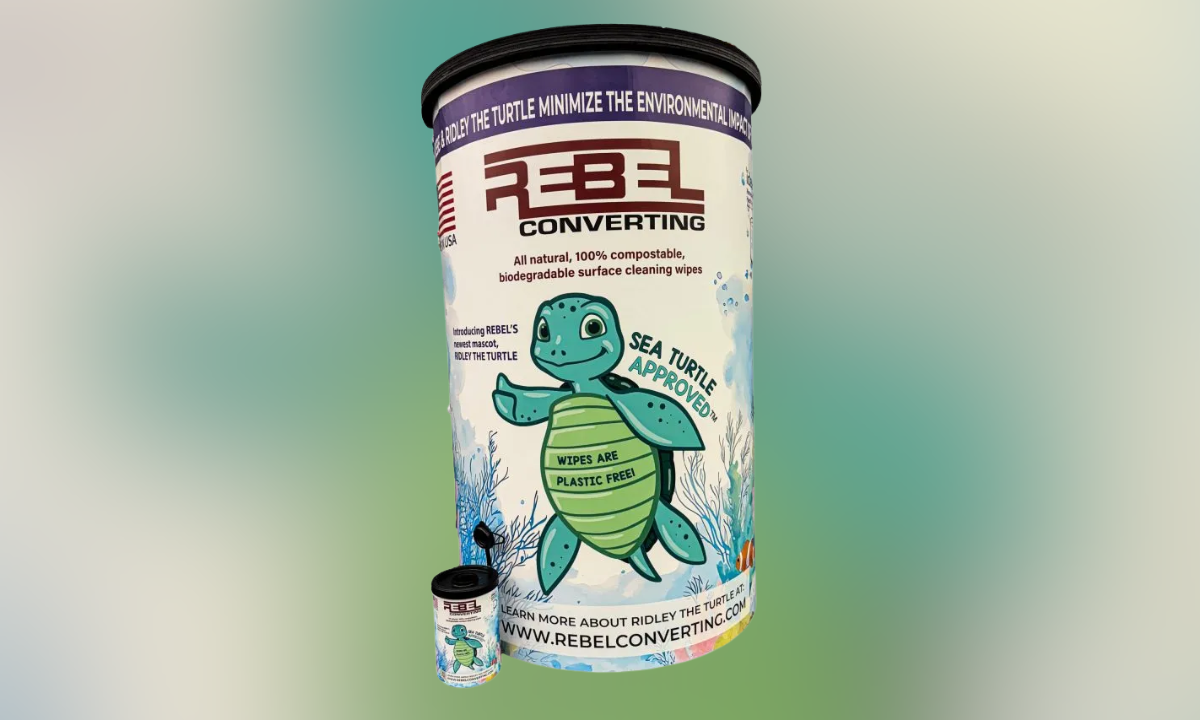
1-Gallon Bucket with Integrated Wipe Dispenser
Rebel Converting has expanded its IML packaging range to include a new 1-gallon bucket with a built-in dispenser — purpose-built for brands seeking a higher-count wipe format. The larger format delivers the same premium IML decoration and structural durability, with the added benefit of a dispensing mechanism suited to commercial, industrial, and high-usage consumer applications.
Higher-count wipe format
The 1-gallon format accommodates significantly higher wipe counts than standard tubs or canisters — ideal for commercial settings, professional users, and bulk-buying consumers who want fewer refill interruptions.
Full IML decoration included
The bucket carries the same award-winning IML decoration as Rebel's other formats — photo-quality graphics, no peeling edges, scuff-resistant throughout the supply chain, and monomaterial for easier recycling.
Built for commercial & industrial use
The integrated dispenser mechanism is designed for high-frequency access in demanding environments — facilities management, foodservice, healthcare, and industrial cleaning where convenience and hygiene matter most.
Premium shelf & brand presence
A larger canvas means more branding real estate. The 1-gallon IML bucket offers brands a bold, high-impact format that commands attention at retail or on the warehouse shelf — without compromising on print quality or finish.
Part of our pillar guide
A Complete Guide to Wet Wipe Manufacturing →
Buyer's checklist: questions to ask your manufacturer about IML
Not all IML capability is equal. When evaluating manufacturers, use these questions to separate genuine expertise from marketing claims.
- Do you produce IML in-house or subcontract it? In-house IML gives the manufacturer direct control over quality and tooling. Subcontracted IML introduces lead time variability and quality handoff risk.
- What container types and polymers do you support? IML works best with PP. Confirm the manufacturer can produce your specific container format (tubs, flip-tops, sachets, canisters) with IML integration.
- Can you show examples or provide samples? Request physical samples to assess print quality, surface finish, and label-to-container edge integration. A manufacturer confident in their IML will send samples readily.
- Do you hold any IML-specific certifications or awards? IMDA recognition is the clearest third-party indicator of IML quality. Ask specifically don't assume that general ISO or manufacturing certifications cover IML performance.
- What are the tooling lead times and costs? IML requires custom mold tooling that includes label placement cavities. Understand the tooling investment and lead time before comparing IML total cost against PSL alternatives.
- What are the minimum order quantities for IML runs? IML economics favour higher volumes. Confirm MOQs align with your production planning to avoid cost penalties from under-utilised tooling.
- How do you handle label artwork files and colour matching? IML print quality depends on file preparation and press calibration. Ask about artwork specifications, colour proofing processes, and how you'll approve production standards before full runs begin.
Frequently asked questions about IML for wet wipe packaging
The unit economics of IML depend heavily on volume. At lower volumes, the tooling investment and setup costs make IML more expensive per unit than pressure-sensitive labels. At scale typically above 100,000 units per run IML becomes cost-competitive or cheaper, because the secondary labeling step is eliminated entirely. For premium or large-volume wet wipe brands, IML typically delivers total cost savings over a product's lifetime.
Not typically. IML requires mold tooling designed to accommodate the label film during the injection molding process. If your current container was designed for pressure-sensitive labels, switching to IML will require new tooling which is a capital investment but a one-time cost. Some manufacturers offer tooling amortisation across production runs to reduce upfront outlay.with IML integration.
In most cases, yes. A monomaterial IML container polypropylene label fused to a polypropylene container is easier to recycle than a container carrying a label made from a different polymer, bonded with adhesive. Many major retailers and recycling schemes specifically prefer monomaterial packaging. IML also eliminates label backing waste, which is a significant waste stream in pressure-sensitive label operations.
IML supports high-resolution offset or digital printing on the label film before molding, enabling photo-quality graphics, fine detail, spot UV, matte and gloss finishes, and metallic effects. Because the label is printed flat on a stable substrate before mold insertion, there are no application-related distortions. The result is typically a higher quality, more consistent finish than shrink sleeves or applied labels.
The In-Mold Decorating Association (IMDA) is the primary international professional body for in-mold decoration practitioners. Their annual awards assess technical quality, innovation, and production excellence in IML and IMD work. When a wet wipe manufacturer holds IMDA recognition, it means their IML capability has been evaluated against the standards of dedicated packaging specialists not simply self-certified. For buyers, it provides independent validation that reduces supplier selection risk.
IML is best suited to injection-molded rigid containers tubs, canisters, flip-top boxes, and similar formats that are produced by injection molding or injection stretch blow molding. It is not applicable to flexible packaging formats such as pouches or flow-wrap sachets, which require different decoration methods. For brands using both rigid and flexible formats, a hybrid approach (IML for rigid containers, digital print for flexible) is common.
Ready to evaluate IML for your packaging?
Talk to Rebel's packaging specialists about whether IML is right for your brand, volume, and commercial objectives.
Request IML packaging samples → Or read our complete guide to wet wipe manufacturing to understand every stage of the process.