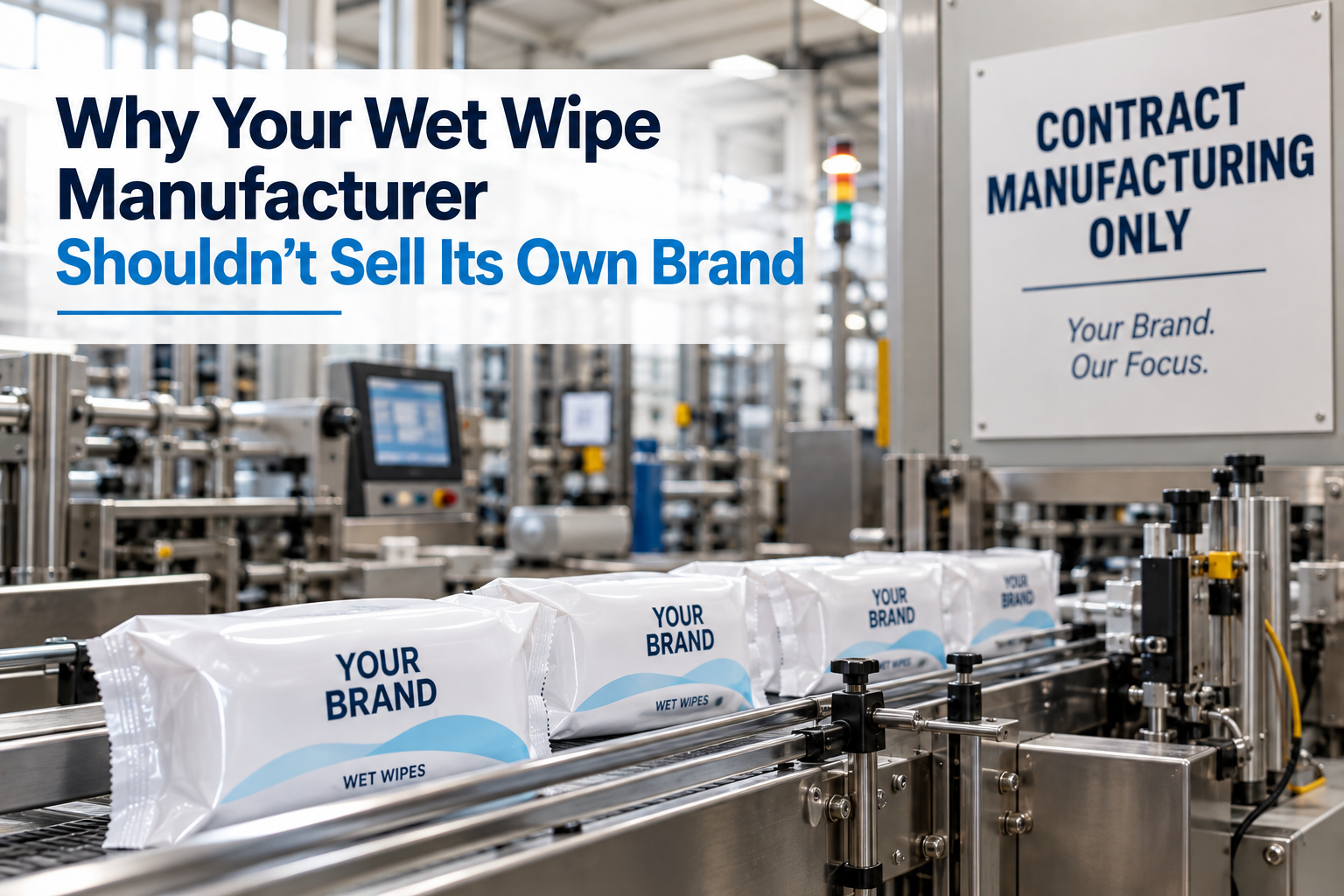
Short answer: A wet wipe contract manufacturer that also sells wipes under its own label is both your supplier and your competitor. It holds your formulation specs, your order volumes, and your launch timing. It also has a financial reason to put its own products first. Brands should choose a pure-play contract manufacturer, meaning a company whose only revenue comes from making other companies' products. Where that isn't possible, they should get contractual protections in writing before sharing anything.
When you hand a manufacturer your product brief, you hand over more than a purchase order. You share your substrate choice, solution formula, packaging format, target cost, forecast volumes, and often the retailers you're pitching. That information makes up most of your competitive position. Whether the company receiving it also wants your shelf space matters a great deal.
What does it mean when a manufacturer sells its own brand?
Many wipe manufacturers run two businesses under one roof. One is contract and private label work for outside brands. The other is a house-brand line, sold under the manufacturer's own label or a parent company's label. The house brand goes through distributors, e-commerce, or retail. Sometimes it is sold to the same buyers the contract customers are trying to win.
Nothing about this is illegal or hidden. It usually shows up as a "Shop," "Our Brands," or "Wholesale" tab on the manufacturer's website. Few brand owners think through what it means for them before they sign.
The four conflicts of interest
1. Your specs sit inside a competitor's building. Your formulation, substrate weight, fold, and count all tell someone how to build a product like yours. A manufacturer with a house brand in your category doesn't need to steal anything. Its R&D and sales teams simply see what works. That matters more for wipes than most products, because FDA's guidance on disposable wipes turns on what the label claims, and your claims are part of the spec.
2. Your volumes are market intelligence. Your order history shows which SKUs are growing, which sizes sell, and when you stock up for a promotion. For a pure contract manufacturer, that data is only useful for scheduling. For a manufacturer with its own brand, it is free market research that you paid for.
3. Capacity goes to the higher margin. Lines get tight when demand spikes. It happened across the wipes industry in 2020, and it happens every cold and flu season. A manufacturer earns a contract margin on your product and a full brand margin on its own. When there is one open slot on the line, the incentives point away from you.
4. You can end up competing for the same buyer. If your manufacturer's house brand is sold into the same distributors or retail accounts you're targeting, your supplier knows your cost structure. It can price against you.
What to look for in a contract manufacturer's business model
Ask these questions before you share a formula or forecast:
- Do you sell any products under your own brand or a parent company's brand? Check the website yourself for a shop, wholesale portal, or "our brands" page.
- What percentage of your revenue comes from contract and private label work? A pure-play manufacturer will say 100%.
- Who owns the formulation and the artwork when we part ways? Get it in the agreement, not in an email.
- Will you sign a mutual NDA before we share specs? Ask who inside the company has access to customer files, especially for private label wipes where the formula is the product.
- How is line time allocated when capacity is constrained? Ask whether contract customers have ever been bumped for internal products.
- Will you agree to a non-compete clause covering our product category? A manufacturer with nothing to protect will sign it easily.
A manufacturer with no house brand can answer all six in under a minute, and these sit alongside the other questions to ask an OEM wet wipe manufacturer.
Pure-play vs. dual-model manufacturers at a glance
| Pure-play contract manufacturer | Manufacturer with its own brand | |
|---|---|---|
| Revenue source | Only customer products | Customer products plus house brand |
| Your specs and volumes | Used to schedule and produce | Visible to a company that also sells in your market |
| Capacity under pressure | Allocated among customers | Internal products compete for the line |
| Same retail buyers? | Never | Possible |
| Success metric | Your brand growing | Both, and they can pull in opposite directions |
How Rebel Converting is set up
Rebel Converting is a family-owned wet wipe contract manufacturer. It was founded in 2012 and has facilities in Milwaukee and Saukville, Wisconsin. Every product we make carries our customer's brand and never ours. We don't run a house brand, a consumer storefront, or a wholesale line that competes with the companies we manufacture for. Our only way to grow is for our customers to grow.
That covers contract manufacturing, private label, and contract packaging, including EPA-registered, FDA-regulated, and OTC products made under cGMP.
If you're evaluating manufacturers, or reconsidering the one you have, talk to our team or read our guide to switching wet wipe manufacturers.
Frequently asked questions
Is it a conflict of interest if my wet wipe manufacturer sells its own brand?
Yes, structurally. The manufacturer holds your confidential specs and sales volumes while earning revenue from products that may compete with yours. Contracts can reduce the risk, but the opposing incentives remain.
How can I tell if a contract manufacturer sells competing products?
Look on its website for a shop, wholesale portal, or "our brands" page. Search its company name and its parent company's name on Amazon and distributor sites. Then ask directly, in writing, whether it or any affiliate sells finished wipes under its own label.
What is a pure-play contract manufacturer?
A pure-play contract manufacturer earns all of its revenue making products for other companies' brands. It has no house brand, so it never competes with its customers for shelf space, buyers, or production capacity.
Can an NDA protect my formula if the manufacturer has its own brand?
An NDA helps, but it is hard to enforce against general knowledge. A manufacturer can't un-learn which formats and claims are selling. It is safer to choose a manufacturer with no competing product to apply that knowledge to. Trade groups such as INDA, the nonwovens industry association, publish supplier guidance worth reading before you sign.
Does Rebel Converting sell wipes under its own brand?
No. Rebel Converting manufactures exclusively for its customers' brands from its Milwaukee and Saukville, Wisconsin facilities.