
Rebel Converting Earns IMDA Recognition for In-Mold Labeling Innovation

(Process, Costs & Choosing a Contract Manufacturer)

Rebel Converting IMDA Awards

What Is Wet Wipe Manufacturing?

Wet wipe manufacturing is the process of producing pre-moistened disposable wipes by combining a nonwoven substrate with a formulated liquid solution, then converting, packaging, and sealing the product for consumer or industrial use.

What Is Wet Wipe Manufacturing (Simple Definition)?
Wet wipe manufacturing is the industrial process of turning nonwoven material and liquid formulation into finished, packaged wipes ready for consumer or industrial use.

What Is a Wet Wipe Contract Manufacturer?

A wet wipe contract manufacturer is a third-party company that produces wet wipes on behalf of a brand, handling everything from formulation and material sourcing to converting, packaging, and regulatory compliance.

Why Do Brands Use Contract Manufacturers?
Brands use contract manufacturers because wet wipe production requires specialized equipment, regulatory compliance systems, and chemical formulation expertise that would be extremely costly to build in-house.

Key Takeaways:

  • Wet wipes are made from nonwoven materials combined with a liquid solution
  • Manufacturing includes formulation, saturation, converting, and packaging
  • Regulatory requirements depend on product claims (cosmetic, disinfectant, etc.)
  • Choosing the right manufacturer impacts product quality, compliance, and scalability
  • U.S.-based manufacturers offer higher regulatory standards and reliability

Key Takeaways (In Simple Terms)

  • Wet wipes = fabric + liquid + converting process
  • Manufacturing requires chemical + mechanical systems
  • Regulations depend on what the wipe claims to do
  • The wrong manufacturer can cause compliance or quality failures
  • Domestic manufacturing improves speed and supply chain stability

How Are Wet Wipes Manufactured?

Wet wipes are manufactured by combining a nonwoven substrate with a liquid solution, then processing the material through converting equipment that cuts, folds, and packages the wipes into their final form.

How Wet Wipes Are Made (Simple Explanation)
The process involves saturating a fabric-like material with a formulated solution and then mechanically converting it into finished, packaged wipes.

Wet Wipe Manufacturing Process

Step Description
Substrate Selection Choosing the nonwoven material (spunlace, airlaid, etc.)
Solution Formulation Mixing water, preservatives, and active ingredients
Saturation Applying the liquid to the substrate
Converting Cutting, folding, and shaping wipes
Packaging Sealing wipes into canisters, pouches, or flow packs
Quality Control Testing for compliance and performance

Why This Process Matters
Each step in the manufacturing process directly affects wipe performance, safety, shelf life, and regulatory compliance.

Written by Loretta Kryshak

Loretta Kryshak is Executive Director of Rebel Reform, Rebel Converting's community outreach arm, where she has spent nine years leading charitable initiative.
https://www.lorettakryshak.com/about
https://rebelreform.org/

February 4, 2026

Rebel Converting, a leading U.S. contract manufacturer of wet and dry wipes in coreless rolls, has been recognized by the In-Mold Decorating Association (IMDA) with two Honorable Mentions in the 2025 IMDA Awards Competition. The honors highlight Rebel’s innovation in in-mold labeling (IML) and sustainable in-mold decorating (IMD) for molded packaging applications.

The awards were presented for Rebel Converting’s IMD Canister program, which demonstrates how advanced materials, digital print technology, and integrated manufacturing can improve durability, sustainability, and brand impact in molded packaging.

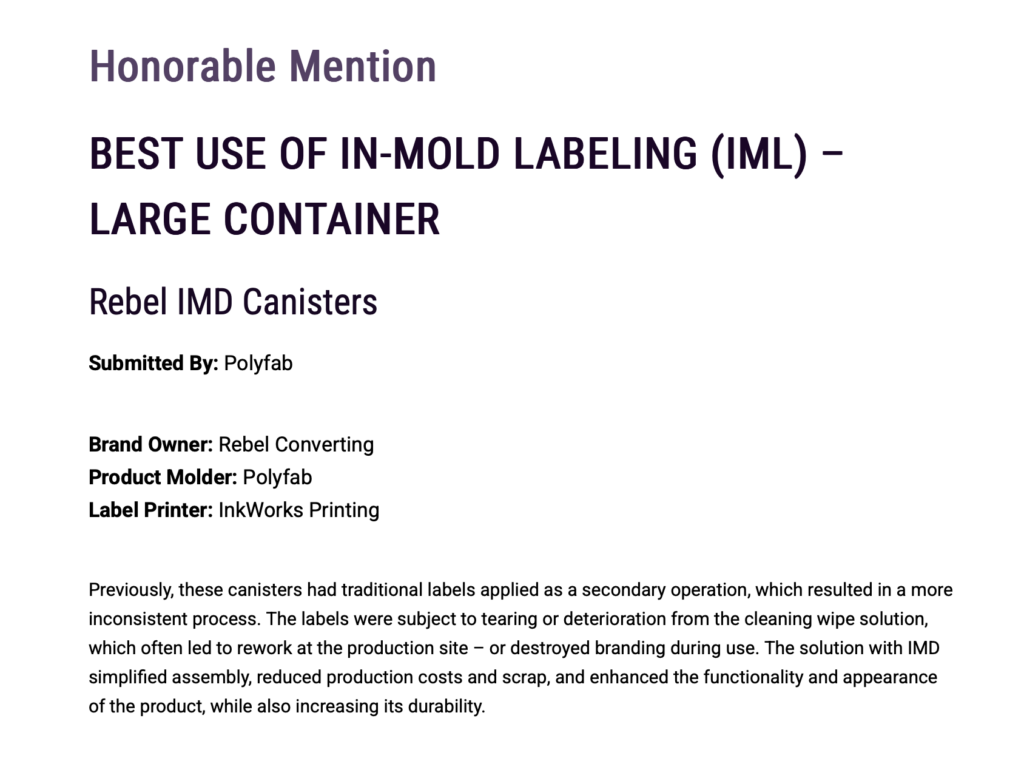
In the Best Use of In-Mold Labeling – Large Container category, the Rebel IMD Canisters were recognized for replacing traditional secondary label application with a fully integrated in-mold solution. By embedding the label directly into the molded container, the design eliminates common challenges such as label tearing, peeling, and deterioration caused by cleaning solutions and repeated handling. The in-mold approach also streamlines manufacturing by reducing secondary operations, lowering scrap rates, and improving overall production consistency.

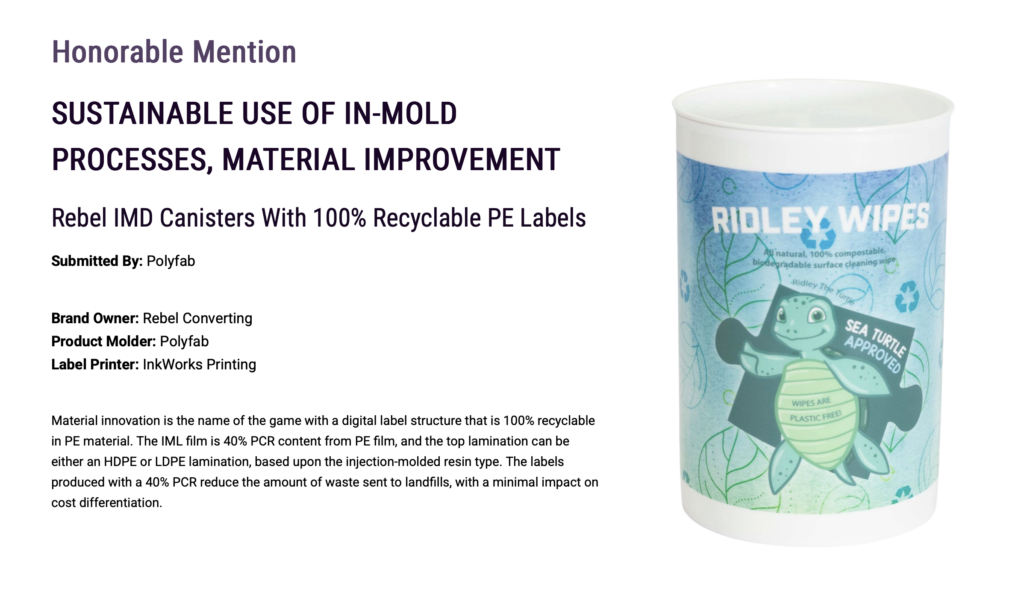
Rebel Converting also earned an Honorable Mention for Sustainable Use of In-Mold Processes – Material Improvement. The project incorporates a 100% recyclable polyethylene (PE) label structure containing 40% post-consumer recycled (PCR) content, paired with a top lamination compatible with HDPE or LDPE molded resins. This mono-material construction supports recyclability while maintaining the durability and visual quality required for demanding consumer and industrial environments.

As a major supplier to the wipes industry, Rebel Converting applies the same innovation mindset to packaging as it does to manufacturing high-quality wet and dry wipes in coreless roll formats. The company’s fully digital IML capabilities provide brand owners with unprecedented flexibility and speed to market.

“Our fully digital IML capabilities allow our customers to achieve graphics on their packaging with the resolution of a magazine,” said Loretta Kryshak of Rebel Converting. “These solutions are extremely competitive and available with very low minimum order quantities, making them ideal for product launches, test marketing, and customization across different markets.”

The IMDA Awards are an international competition recognizing excellence in in-mold labeling, decorating, and electronics, with entries judged on design complexity, innovation, functionality, and manufacturing execution. This recognition places Rebel Converting among a select group of global leaders pushing the boundaries of in-mold technology.
You May Also Like...

0 Comments

Submit a Comment

Your email address will not be published. Required fields are marked *