Watch the video below to see an exclusive interview conducted by Nonwovens Industry about President and founder, Mike Kryshak of Rebel Converting. In the interview Kryshak discusses Rebel’s plan to expand their new plant in Saukville, WI by late 2023 as well as his plans for the wipe industry and what we can do to reduce our carbon footprint.
Interviewer:
Mike Kryszczak has been in the wipes industry for more than three decades. His most recent company, Rebel Converting, is the inventor of the coreless roll. Mike, can you tell me a little bit more about this?
What is the coreless roll?
Mike Kryshak:
Well, we didn’t actually invent the coreless rolls. They’ve been around for a long time. As you know, like a toilet paper has a paper core in the middle.
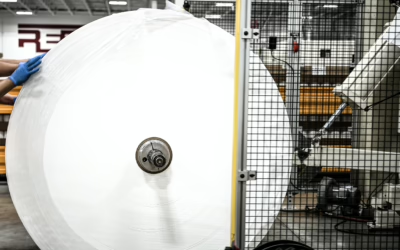
We make a lot of different rolls with a lot of different substrates that don’t have that paper in the center. So you can pull it through the middle and put it through a canister. So when it comes to capacity in that type of package configuration, whether it’s a dry coreless roll or whether it’s a wet wipe in a canister, we have over 2 billion square yards of capacity annually available.
And so we’re actually continuing to buck the trend. After COVID, a lot of people kind of stepped back, and we’ve actually been kind of doubling down on the fact that we feel that non-wovens, especially disinfectant wipes, hospital-grade disinfectant wipes, shopping cart wipes, are going to be at a much higher level than they were pre-COVID. So I think a few of the converters were a little bit caught off guard as we were, because you’re running three plants, five shifts per plant, you’re never shutting down, and then all of a sudden the brakes get hit, and it takes a little while.
It was a relatively abrupt stop.
Interviewer:
But you are actually in investment mode. You’ve recently announced you’re going to change locations.
Mike Kryshak:
Yeah, we are in expansion mode. We just sold our filling facility in Salkville, which was our original facility. We had put an addition in there in 2012 and 2018.
We bought a facility an eighth of a mile away that’s just under 100,000 square feet, and we’re putting about a 70,000-square-foot addition on it. And unfortunately with materials and the time, our time frame is probably out about a year and a half for full completion.
[Speaker 2]
So looking forward, the wipes market, you think the growth trend is going to continue?
There’s no doubt the growth trend is going to continue. I will say I’ve been hearing green wipes, biodegradable wipes, good for the environment, low-carbon footprint for years and years. But I think this time I have a feeling it’s going to stick a little bit more.
I’ve always been an advocate of reusable primary packaging. So like, for example, our Xtreme canister, you can step on it. As opposed to a regular canister that would just fall apart.
Well, we didn’t use three times more plastic just for fun. We did it so we could put refill packages inside of them, refill pouches, which are box-gusseted pouches. So you can reuse that container multiple times.
And of course the refill pouches take up 99% less landfill, 96% less plastic. So there’s certainly a movement. We’re hearing that a lot, especially from the big consumer companies.
I think they’re taking carbon footprint a lot more seriously than they have in the past.
Interviewer:
Is Rebel doing anything with wipes innovation to reduce carbon footprint or offering any lines that offer a little bit more sustainability choices to your customers?
Mike Kryshak:
We’re certainly looking at products that are compostable, biodegradable, are made from renewable resources. But we’re also looking at some of those standardized non-wovens and saying how can we reduce the outside packaging, like I mentioned before, the container. So you aren’t throwing away a container every time.
A lot of the mills have been asking us our thoughts on recyclability of their materials, what can they do to reduce their carbon footprint. And we’ve come up with some ideas. There are some new substrates here at the show that people should check out.
I’m not going to say who they are because I can’t show any favoritism. But we worked with a few companies on some developmental products that they’re showing here at the show. And I’ve been pretty impressed with what some of these people are coming out with.
0 Comments